
Résumé du cours : À l’ère de la transformation numérique, les plateformes constituent des acteurs centraux capables de restructurer les marchés, de redéfinir les relations entre producteurs et consommateurs et de générer de nouvelles formes de création de valeur fondées sur les données, les algorithmes et les effets de réseau.
Ce module vise à analyser les plateformes numériques comme modèles économiques particuliers dotés de mécanismes stratégiques spécifiques. Il permet aux étudiants de comprendre les mécanismes de fonctionnement des plateformes multi-faces, les logiques d’intermédiation, ainsi que les facteurs qui expliquent leur croissance rapide et leur capacité à dominer certains marchés.
Le module aborde les différentes étapes du développement d’une plateforme : conception du modèle d’affaires, structuration de l’écosystème, stratégies d’acquisition des utilisateurs, gouvernance des interactions, monétisation, gestion des données et expansion internationale.
Public cible : Le module est destiné aux étudiants de la 2ème année du second cycle de la spécialité "Intelligence Economique et Stratégies Compétitives".
Visées d'apprentissage : La compétence visée par ce cours est d’être capable d’analyser le fonctionnement des plateformes numériques, de concevoir un modèle de plateforme et de prendre des décisions stratégiques argumentées dans des contextes variés.
- Enseignant: narimene assi
- Enseignant: elearning oran
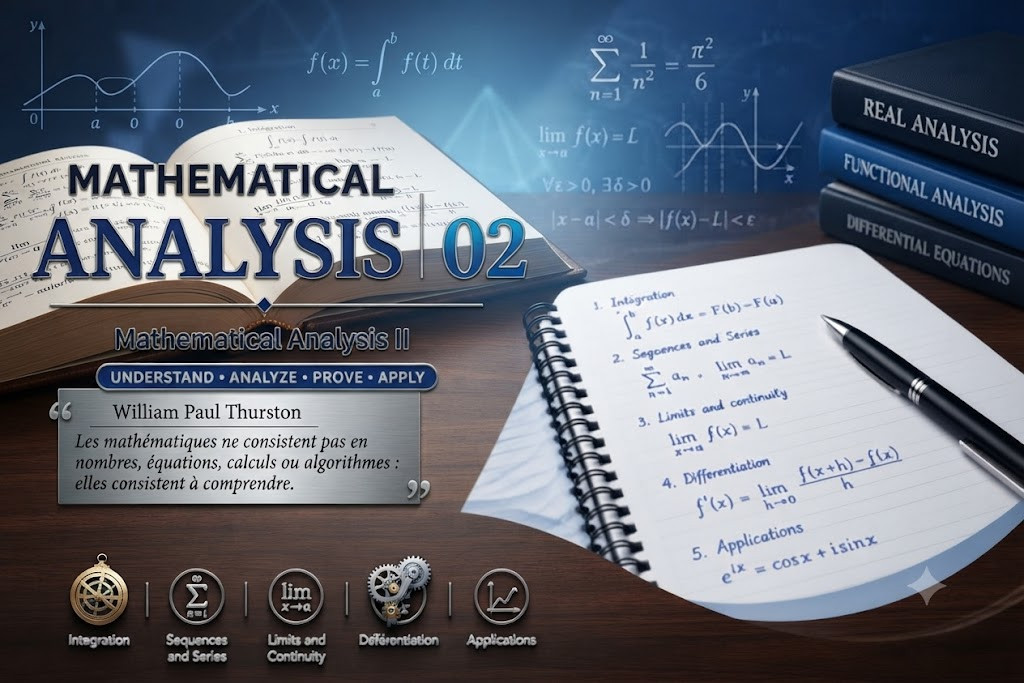
Mathematical Analysis II is a fundamental course that helps students develop their understanding of basic concepts in mathematical analysis and improve their analytical and problem-solving skills.
The course covers important topics such as integrals, Riemann integrals, integration techniques, and Taylor expansions.
These concepts provide students with the necessary tools to solve mathematical problems, analyze continuous functions, and develop logical and analytical thinking.
Course Summary:
- The first chapter introduces definite and indefinite integrals, antiderivatives, and their main properties, along with methods for computing integrals through several examples and excercices.
- The second chapter deals with Taylor expansions and includes solved exercises.
Target Audience:
This course is intended for first-year preparatory students in the first cycle at Oran Graduate School of Economics, as well as for anyone wishing to gain an introduction to the Analysis module of the second semester.
Learning Objectives:
This course aims to enable students to:
- Understand the basic concepts of integrals and their properties.
- Compute simple and definite integrals using appropriate techniques.
- Apply different methods of integration, such as substitution and integration by parts.
- Understand the concept of the Riemann integral and its applications.
- Identify and recognize the limited development (Taylor expansion) of functions.
- Use Taylor expansions to approximate functions and solve mathematical problems.
- Analyze the behavior of functions using integral and approximation methods.
- Develop logical reasoning and problem-solving skills in mathematical analysis.
- Enseignant: norelhouda beghersa
- Enseignant: elearning oran
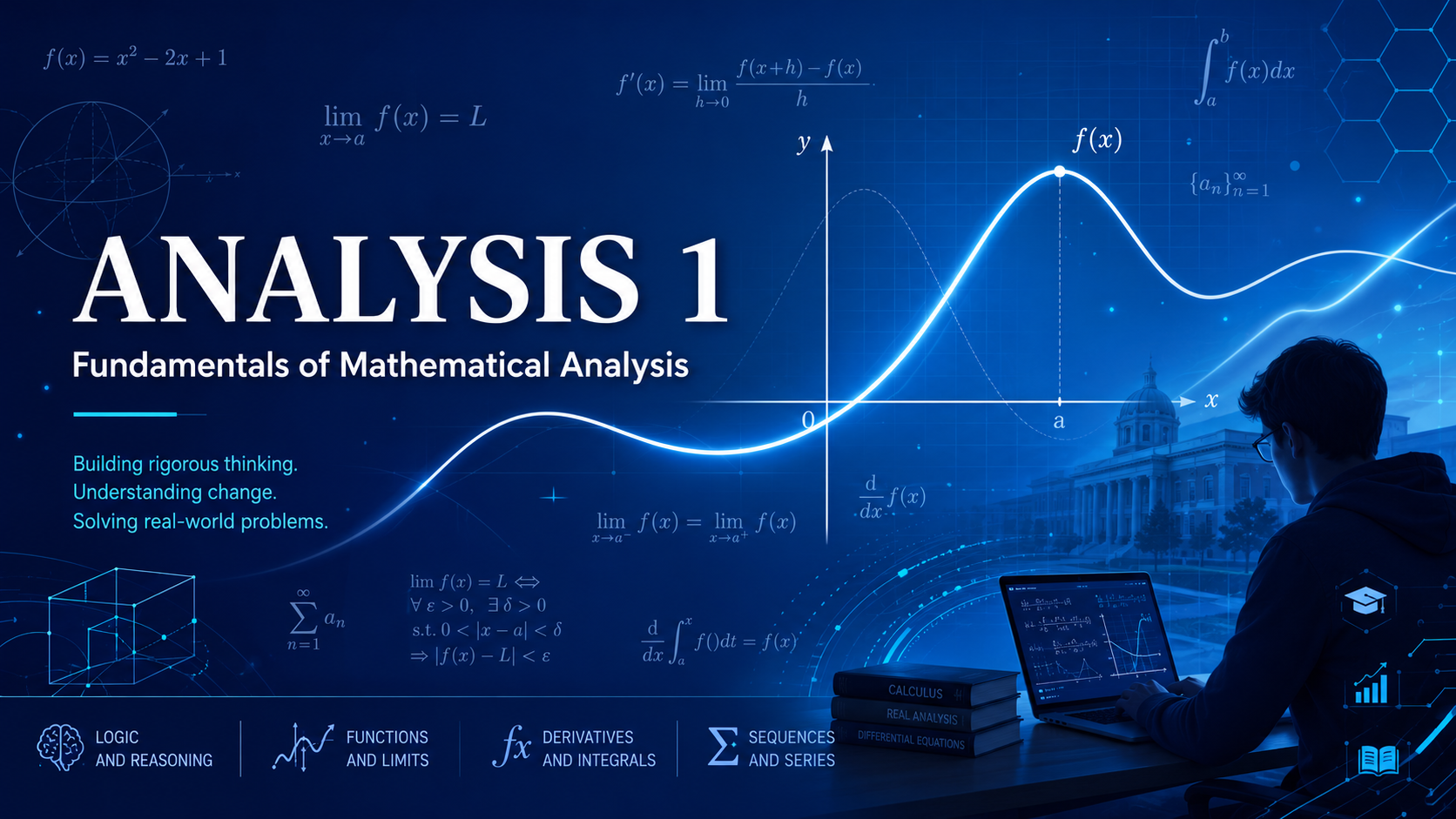
Analysis 1 is a fundamental course designed to build your mathematical reasoning skills and prepare you for advanced studies in economics and quantitative sciences. This course is primarily intended for first-cycle students in the Preparatory Classes of the Higher School of Economics. However, anyone interested in learning the fundamentals of Mathematical Analysis can easily follow and benefit from this course. Thanks to its structured and accessible approach, the course is both easy to adapt to different learning backgrounds and highly engaging for motivated learners.
Throughout this course, you will develop a solid understanding of key concepts in mathematical analysis, including: Real Numbers, Numerical Sequences, Limits and Continuity, Differentiability.
These concepts provide essential tools for modeling and analyzing economic phenomena, solving quantitative problems, and developing rigorous analytical thinking.
Learning Outcome: By the end of this course, students will be able to:
Manipulate and analyze real numbers and algebraic expressions, Study numerical sequences and determine their behavior, Calculate and interpret limits of functions, Analyze the continuity of functions, Compute derivatives and use them to study function variations, Apply mathematical reasoning and problem-solving methods in a rigorous manner, Develop autonomy, critical thinking, and logical reasoning skills necessary for further studies in economics and mathematics.
Dr. ZARAT Ahlem
Hight School of Economics of Oran
- Enseignant: elearning oran
- Enseignant: ahlem zarat